
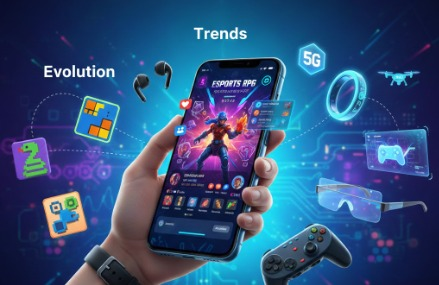
Mobile gaming has exploded from a niche time-killer into the single largest revenue stream in the entire gaming industry. What started with simple, pre-installed games has morphed into a sophisticated ecosystem featuring high-fidelity graphics, competitive esports, and advanced social integration. This comprehensive look explores how far mobile gaming has come, the trends driving its current success, and the technological leaps defining its future.
The Journey—Tracing the Evolutionary Stages
The history of mobile gaming can be segmented into three distinct eras, each marked by a revolution in hardware and distribution:
Stage 1: The Dawn of Simplicity (Late 1990s – Mid-2000s)
This era was dominated by feature phones. Games were basic, pre-installed, and focused on instant gratification.
The Icon: ‘Snake’ (on Nokia phones) defined portability.
Key Innovation: The introduction of Java (J2ME) platforms allowed for games to be downloaded after purchase, offering developers slightly more creative freedom.
Stage 2: The App Store Revolution (2007 – Early 2010s)
The arrival of the iPhone and Android fundamentally changed the landscape. The launch of the App Store and Google Play created a direct, centralized marketplace for games.
The Model: The Freemium (Free-to-Play with optional in-app purchases) model became the global standard.
The Hits: Casual mega-hits like ‘Angry Birds,’ ‘Temple Run,’ and ‘Candy Crush Saga’ brought gaming to a massive, non-traditional audience.
Stage 3: The Mid-Core Convergence (Mid-2010s – Present)
With stronger processors, faster RAM, and better GPU capabilities, mobile devices began to rival dedicated consoles.
The Shift: Mobile gaming moved from simple puzzles to complex Mid-Core and Hard-Core experiences, featuring rich multiplayer battles and deep progression systems.
Key Titles: ‘PUBG Mobile,’ ‘Genshin Impact,’ and ‘Call of Duty Mobile’ demonstrated that mobile platforms could handle massive worlds and competitive gameplay.
The Present Day—Dominant Trends and Market Drivers
The current mobile gaming market is defined by several powerful and interconnected trends:
1. The Ascent of Mobile Esports and Competitive Gaming
Mobile is now a legitimate platform for professional competitive gaming. High-level tournaments are regularly hosted for titles like ‘Mobile Legends: Bang Bang’ and ‘Free Fire,’ boasting viewership numbers and prize pools that rival traditional PC esports.
2. Hybrid-Casual Games: The Best of Both Worlds
This is the new evolution of monetization and retention. Hybrid-casual titles combine the initial simplicity and immediate feedback loops of hyper-casual games with the long-term goals and monetization depth of core genres like RPGs.
3. Social and Cross-Platform Integration
Modern games are inherently social. Features like in-game voice chat and guild systems are standard. Furthermore, cross-platform play (allowing mobile users to play with console/PC users) is blurring the lines between ecosystems, expanding the pool of potential opponents and teammates.
4. Advancements in Monetization Strategies
While In-App Purchases (IAPs) remain crucial, the industry is increasingly diversifying:
Ad-Supported Models: Highly targeted advertising generates significant revenue.
Battle Passes: A popular subscription-like model that incentivizes regular play with tiered rewards.
Subscription Services: Services offering ad-free play, exclusive content, or access to game libraries.
Innovation Pipeline—The Future Of Mobile Gaming
The next decade will be characterized by the integration of frontier technologies, pushing the boundaries of immersion and accessibility:
Augmented Reality (AR) Integration
Description: AR uses the device’s camera to superimpose digital elements onto the real-world environment.
Expected Impact: Beyond ‘Pokémon GO,’ AR will enable richer, location-based games for scavenger hunts, fitness, and interactive storytelling in the user’s immediate surroundings.
5G and Cloud Gaming
Description: This involves high bandwidth and ultra-low latency (near-zero lag) networks.
Expected Impact: Cloud gaming services (e.g., Xbox Cloud, GeForce NOW) will stream high-fidelity, console-quality games flawlessly to any mobile device, completely decoupling game quality from the phone’s hardware capabilities.
Artificial Intelligence (AI)
Description: AI is being used for generative content creation (assets, missions) and dynamic AI for non-player characters (NPCs).
Expected Impact: AI will create smarter, more adaptive enemies and highly personalized gameplay experiences that adjust to the player’s skill level in real-time.
Web3, Blockchain, and Digital Ownership
Description: Integrating non-fungible tokens (NFTs) to give players verifiable ownership of in-game items (skins, assets).
Expected Impact: The rise of Play-and-Own models, where the in-game economy is more transparent and players can potentially sell their acquired digital assets, creating a true player-driven economy.
Conclusion:
The Pocket-Sized Platform of Power
Mobile gaming has completed its transition from a gimmick to the most powerful platform in the global entertainment sector. Fueled by better hardware, faster connectivity, and creative monetization strategies, the industry shows no sign of slowing down. For players, this means access to richer, more competitive, and deeply social experiences, all available right in the palm of their hand. The future promises a convergence where the lines between mobile, console, and PC gaming become increasingly irrelevant.
Leave Comment